Visualizzazione post con etichetta installazione. Mostra tutti i post

mercoledì 3 agosto 2016

Carne di bambola sott'olio / Doll meat in oil


CARNE DI BAMBOLA SOTT'OLIO
Carne di bambola (1930), olio di semi, contenitore in vetro, stoffa, corda.
Roccioletti 2016

DOLL MEAT IN OIL
Doll meat (1930), seed oil, glass container, cloth, string
Roccioletti 2016

domenica 20 settembre 2015

THE VENICE VENDING MACHINE - che valore diamo all'arte?

Con piacere ho raccolto l'invito a partecipare con alcune mie opere
alla "Venice Vending Machine" di Marina Moreno. Se siete alla Biennale di Venezia,
non dimenticatevi di "provare" questa installazione.

THE VENICE VENDING MACHINE
Che valore diamo all'arte?

Vernissage 25/09/2015 19:00

Chiuso il lunedì
10.30 - 12.00
16.00 - 18.30

Serra dei Giardini
Viale Giuseppe Garibaldi 1254
Venezia

The Venice Vending Machine project is a conceptual live-art installation originally conceived and created by Venetian artist Marina Moreno in the summer of 2010.

It seeks to present and promote emerging and already established artists during prestigious art events, whilst reflecting and opening a dialogue with the audience about the value of art in our society.  The Venice Vending Machine is a project that travels to prominent artistic sites worldwide responding each time to a different theme, determined by the place where it exhibits whilst growing as an international union of artists and reputation.

A large part of the work is to instigate, cultivate and promote an exchange amongst artists, cultural associations and art professionals internationally, always encouraging active and direct participation with the public. 

The live art process, essential to the installation is public, performative, inclusive participatory, interactive, educational and collectively aimed at empowering artists internationally and promotes future collaborations. 

Drawing from her live art background, Marina opens the dialogue to the audience by posing the question: “How do you value art?”

Here all the art works become equal and the “buyer” will decide a value by giving a symbolic offer in exchange for a token without knowing which art piece he/she will receive after an exchange about art and why we need art in our society.  From here an ongoing dialogue is spurred depicting many facets of the relationship that the public and the art professional have with art amongst which are:

Individual views about how art promotes intrinsic values in our life and society.
How does art influence our ideas about our past, our historical values and how it inform our present and future?

Playfulness is essential to creativity and quintessential to art. Through the game of interaction and the inherent chance of the machine, an automatic distributor, an exchange takes place for both the artists and the receiver of the art work.The Venice Vending machine is a serious reflection on the dynamics of the market and the function of the gallery, whilst re-establishing for a moment the freedom of the use of the art in its function of displacement, surprise and subversion of pre-established rules.

The diverse and high quality art, some unique and limited pieces produced by both emerging and established artists and placed in each sphere with relevant contact, web site and short descriptions of their art work. From here chance will provide the future and direct connection between the artist and the recipient who are actively invited by Marina to  communicate with each artist further.

The installation attracts art professionals, curators, collectors and people that would otherwise never enter a gallery. The call out is purposely directed to artists coming from different disciplines as it is intriguing and enriching to have the different media within the bubbles, all having views outward from different vectors in the sphere.

The Venice Vending Machine is an ongoing project that invites future collaboration around our world.


lunedì 22 giugno 2015

Kipple

The kipple is the "thing" that, walking the streets,
we see on the ground but we do not know exactly what it is,
or rather what it was: perhaps a piece of a bumper,
of an umbrella, of an ice cream spoon,
if it is plastic, metal or fabric,
with molded smooth edges or rough ones for the break-point.


The streets of every city are strewn with amorphous fragments,
escaped the garbage but in any case not recyclable,
moved in space by the passage of a car
or by a gust of wind stronger than usual,
handheld briefly by curious children
before their mothers told them to throw away it
saying "do not pick things off the ground."


Without a purpose, the shape unusable,
the kipple takes part, indeed it has a perennial farewell
from the universe of things that humans produce and use;
subjected to the action of weather and using
it is the first line to fall in the war of everything
against the inevitable entropic matter's destiny.


The kipple is also a messenger, a time traveler from the future
telling a truth that no one wants to hear:
all the matter, sooner or later, breaks up, transforms,
returns to the shapeless state from which for a short period
it was torn by the genius of the man who organized it,
first with the thought and then with the hands,
to meet a need, to chase a desire.


Ironically, if the man is not a mistake of evolution
but one of the steps towards the complexity
and man in turn produces unconsciously and naturally kipple
the circle is closed and disorder back to the disorder.


------------------------------

Notes:

> http://nl.urbandictionary.com/define.php?term=kipple

Kipple is a word coined by the remarkable science fiction writer Philip K. Dick.
It refers to the sinister type of rubbish which simply builds up without any human intervention. Eventually, one day, the entire world will have moved to a state of kipplization.

From Phil Dick's "Do Androids Dream of Electric Sheep?" 

JR - Kipple is useless objects, like junk mail or match folders after you use the last match or gum wrappers of yesterday's homeopape. When nobody's around, kipple reproduces itself. For instance, if you go to bed leaving any kipple around your apartment, when you wake up the next morning there's twice as much of it. It always gets more and more. 

Pris - I see. 

JR - There's the First Law of Kipple, "Kipple drives out nonkipple." Like Gresham's law about bad money. And in these apartments there's been nobody there to fight the kipple. 

Pris - So it has taken over completely. Now I understand. 

JR - Your place, here, this apartment you've picked - it's too kipple-ized to live in. We can roll the kipple-factor back; we can do like I said, raid the other apartments. But - 

Pris - But what? 

JR - We can't win. 

Pris - Why not? 

JR - No one can win against kipple, except temporarily and maybe in one spot, like in my apartment I've sort of created a stasis between the pressure of kipple and nonkipple, for the time being. But eventually I'll die or go away, and then the kipple will again take over. It's a universal principle operating throughout the universe; the entire universe is moving toward a final state of total, absolute kippleization.

-----

> http://www.technovelgy.com/ct/content.asp?Bnum=128

Kipple seems to be a combination of entropy and capitalism. 
I don't think past civilizations had the resources to produce so much packaging
to hold our stuff until we buy it or consume it.

Don't forget the First Law:
"There's the First Law of Kipple… 'Kipple drives out nonkipple'."

Kipple is useless objects, like junk mail or match folders after you use the last match or gum wrappers or yesterday's homeopape. When nobody's around, kipple reproduces itself. For instance, if you to go bed leaving any kipple around your apartment, when you wake up there is twice as much of it. It always gets more and more. No one can win against kipple, except temporarily and maybe in one spot.

According to the philosopher of kipple in the novel, J.R. Isadore, "the entire universe is moving toward a state of total, absolute kippleization." Physicists will note the similarity to the concept of entropy, which is most usually taken to refer to the tendency of closed systems toward increasing disorder.

I like the definition taken from classical thermodynamics, that entropy is a quantitative measure of the amount of thermal energy not available to do work. In the 21st century, we seem to be working as hard as we can to take available resources and transform them into objects that cannot be used for anything (kipple). We are doing this socially as well; by using welfare, we encourage our human resources not to do work, either. If we can recycle paper, we can recycle people, too.

Are you having a little problem with kipple where you live?
Maybe you need the high tech trash can from Islands in the Net, by Bruce Sterling

"Is there a relationship or correlation between kipple and noise? Audible kipple? Does noise somehow accumulate the way kipple does? If so, what does it leave behind? "
( 4/28/2004 4:41:22 PM )

"Interesting thought. Urban environments have a lot of "waste noise" (as opposed to useful noise, like the sound a garbage truck makes when it backs up!). However, noise tends to dissipate; it is absorbed by objects and is attenuated by its passage through the atmosphere. Unlike kipple, which never seems to go away. On the other hand, Frederick Brown wrote a stunningly original story called The Waveries in 1945, in which sounds had a life of their own. (Philip K. Dick called that story one of the best he ever read.)"
(Bill Christensen 4/28/2004 5:45:03 PM )

"Dick's novel Do Androids Dream of Electric Sheep? was not "Published by Del Rey in 1968." It was published in 1968 by Doubleday. Del Rey is one of the paperback reprinters who eventually issued it, though not the first. (Got it, thanks! -Bill)"
(Gregory Feeley 7/10/2005 8:17:49 PM )

"E-waste seems a lot like specific kipple to me. Objects that have outlived their usefulness and cannot be recycled and as such, have nowhere to go but on the floor."
(Mysterious Bill 3/23/2010 5:51:47 PM )

"The analogy of Kipple to the social products of a welfare system is quite repulsive. It brings an unnecessary socially normative dimension into the trash-definition as intended by Dick. "
(Boris 3/19/2012 4:18:56 AM )

"Just realized a more horrifying concept - Kipple that can create more kipple, self-replicating waste. "
(Gatomon41 4/23/2013 10:36:32 PM )

-----

> http://www.shmoop.com/do-androids-dream-of-electric-sheep/kipple-symbol.html

Symbolism, Imagery, Allegory
Don't look, but chances are there's kipple hanging around your life somewhere right now.

No, no, it's not you specifically—it's just that kipple is everywhere, because it's the representation of decay and degeneration in physical form. In Do Androids Dream of Electric Sheep?, it's really everywhere. World War Terminus has left our home planet in an awful mess: entire cities have been leveled, radioactive dust is getting in everyone's hair, and people have left the planet to go seek a new existence in the space colonies—leaving behind all their stuff. As that stuff rots and decays, it becomes kipple.

Isidore describes it:

"Kipple is useless objects, like junk mail or match folders after you use the last match or gum wrappers or yesterday's homeopape. When nobody's around, kipple reproduces itself. For instance, if you go to bed leaving any kipple around your apartment, when you wake up the next morning there's twice as much of it. It always gets more and more." (5.23)

So, in other words, just like the dishes in our sink?

We kid, we kid. But that does give you an idea of what this means. The decay of an entire planet or species might be too much for us to fully grasp, but we experience the disrepair of consumer goods in our everyday lives. Anyone who has ever maintained an attic, rented out a storage unit, or had a locker can tell you how true this is. As we collect stuff, and the stuff just spreads out, growing in number, expanding the mess as it goes, bringing disarray into our lives with a tsunami of junk.

Is there hope against this state of decay? Maybe:

"No one can win against kipple," [Isidore] said, "except temporarily and maybe in one spot, like in my apartment I've sort of created a stasis between the pressure of kipple and nonkipple, for the time being. But eventually I'll die or go away, and then the kipple will again take over." (5.31)

Maybe it's time to buy a tiny house.

-----

> http://www.thisiscolossal.com/2014/09/kipple-dan-tobin-smith/

About 3 months ago photographer Dan Tobin Smith set up a website to ask the public to donate kipple: junk that was lying around their house. “It’s time to free yourself of the pointless or unused objects in your life,” read the plea. “Give them a purpose as part of Dan Tobin Smith’s installation for the London Design Festival 2014.”

Sure enough, the donations began coming in and in no time at all Smith had enough junk on his hands to create a sprawling installation that filled an entire floor and mezzanine, “carpeting 200-square-metres with a dense, precise, chromatically-themed arrangement of thousands of objects.” The objects are so carefully placed that gradients seem to blend together seamlessly.


The fictional word Kipple was coined by science fiction writer Philip K Dick. Kipple appears in his 1968 novel “Do Androids Dream of Electric Sheep” (the film adaptation was Blade Runner) and is used to describe useless, pointless stuff that humans accumulate. It served as the inspiration for Smith’s installation “The First Law of Kipple,” which was part of London Design Festival this month.

sabato 3 maggio 2014

TI TROVO IN-FORMA(E)


TI TROVO IN-FORMA(E)
ovvero il nonno guarda Kaori che si allena, e si chiede che senso abbia, in fondo


“La nostra vita è troppo breve” disse “oppure siamo troppo disattenti, per cogliere la trasformazione delle cose.” Gli elefanti si muovono verso la pozza d’acqua, scuotendo lentamente le orecchie. “Molto plausibile che nemmeno vogliamo farlo”. Indicò con il dito cose che davanti a noi non c’erano, come se le stesse vedendo davvero: “Quello che chiamiamo bicchiere, tavolo, penna... lo chiamiamo così per l’uso, conferiamo uno scopo ad un’aggregazione di materia, nel tempo dato tra il suo essere così e il suo prossimo disgregarsi. Tra quanto tempo?” chiese. Il vulcano inizia ad eruttare, la pressione dei gas incandescenti fa esplodere la sommità del cratere con un boato udibile a chilometri di distanza. Rimase in attesa, come se davvero si aspettasse una risposta, ma sapevamo che era un bell’espediente retorico. “Un giorno, un anno, un eone... niente resterà strutturato così, tutto si trasformerà.” La Luna si allontana dalla Terra di 3,8 cm all’anno; allo stesso tempo, in virtù del principio di conservazione dell’energia, questo fenomeno determina anche un leggero rallentamento del moto di rotazione attorno al proprio asse della Terra. Fra 7 miliardi di anni un giorno terrestre durerà quanto 47 giorni attuali, e la luna apparirà fissa nel cielo, visibile solo da un emisfero, e molto più distante. Sempre che il Sole non abbia distrutto prima il sistema solare e i suoi pianeti. Abbassò il capo, spostò il peso su una gamba, poi sull’altra, alzà di nuovo lo sguardo su di noi. “Due sono le forze fisiche che entrano in gioco nel processo di trasformazione. La forza di attrazione della materia, ed un’energia che invece tende a disgregarla, la cui origine è attualmente motivo di indagine”. Sorrise. “Da ragazzo mi chiedevo perchè la materia attraesse...” ridacchiò scuotendo la testa, ma non ci sfuggì una certa nostalgia nella sua espressione. Il DNA è un acido nucleico che contiene le informazioni genetiche necessarie alla biosintesi di RNA e proteine, le molecole necessarie per lo sviluppo e il funzionamento degli organismi viventi. E’ un polimero organico formato da monomeri chiamati nucleotidi; i nucleotidi sono costituiti da un gruppo fosfato, dal deossiribosio e da una base azotata. “Dunque, riprendendo: usiamo la materia già configurata, oppure la configuriamo in base alle nostre possibilità per i nostri scopi, attribuendo alle configurazioni della materia nomi ed usi; inoltre, attribuiamo ad essa significati e, a volte, ne facciamo dei simboli.” Agitò la mano come se stesse scrivendo su un’immaginaria lavagna. “Simbolo deriva dal greco sun-ballo, cioè metto insieme, questo lo sappiamo. Pochi invece sanno che in greco il simbolon era una tessera con caratteri geometrici, che veniva spezzata quando si faceva un accordo: ciascuna delle parti ne conservava metà, così che avesse prova del patto stipulato con l’altra parte. Dunque” allargò le mani, indicando due opposti “la realtà da sola è incompleta: da un lato c’è la materia, dall’altro noi che le attribuiamo quello di cui prima parlavo”. La meccanica quantistica descrive la radiazione e la materia sia come un fenomeno ondulatorio che allo stesso tempo come entità particellari; questo dualismo onda-particella è formulata nel principio di indeterminazione di Heisenberg. Incrociò le braccia. “Adesso arriva la parte che non piace ai borghesi” disse “Parte che non piace ai borghesi perchè, come disse qualcuno, la tragedia irrisolta della borghesia è quella di essere riuscita a comprare tutto, tranne che l’immortalità. Comunque... gran parte dell’inquietudine umana pare derivare proprio da questo: non potendo arrestare la propria trasformazione fisica, oppure trovarle un senso – essendo fatti di materia anche noi – cerchiamo stabilità nelle cose, nel loro essere ben definite, con un nome, un uso, un valore simbolico. Distogliendo lo sguardo, oppure i pensieri, quando le cose si rivelano per quello che sono: materia in continua trasformazione.” Leonardo da Vinci scrive il Codice del Volo degli Uccelli intorno all’anno 1505, a Firenze. Analizza il volo e la struttura fisiologica degli uccelli, per poi passare a progetti di macchine che consentano all’uomo di volare. E’ di questo periodo (così dice la leggenda) il tentativo di volo di Leonardo dalla collina di Montecederi, a Fiesole. Si fermò un attimo, pensieroso. Stava per dire qualcosa, poi ci ripensò. Ci guardò per un po’. “Anche l’arte ha a che fare con il tempo. Su due piani” parlava lentamente, forse pensava in questo modo di aiutarci a seguire il suo salto logico “il primo, quando si confronta direttamente con la questione del tempo, che è il luogo dove avviene questa trasformazione della materia. Il secondo, intrinseco: tutte le opere d’arte, prima o poi, si trasformeranno in altro, disgregandosi. I curatori e i restauratori d’arte questo lo sanno bene, e tra di loro – mai in pubblico, solo tra di loro, badate – ne discutono, di questa impermanenza di fondo, di questa falla nel sistema che solo la brevità della vita umana consente di nascondere”. Le piante sono un regno di esseri viventi che comprende circa 350.000 specie di organismi; le caratteristiche fondamentali sono la capacità di sintetizzare le proprie molecole organiche a partire da sostanze inorganiche, utilizzando energia non derivante da sostanze organiche assimilate; l’uso della fotosintesi, che permette loro di cattuarre parte dell’energia solare trasformando l’anidride carbonica in zuccheri e altre sostanze; sono formate da cellule eucariote, dotate di un vero e proprio nucleo; le loro pareti cellulari sono strutturate con una base di cellulosa, e le cellule stesse possono immagazzinare amido come fonte energetica di riserva. Fece qualche passo verso di noi, si fermò attendendo da noi una domanda che non sarebbe mai stata formulata. “L’arte rende sempre visibile l’inquietudine umana, e la domanda sul perchè la materia porti con sè, insieme alla sua esistenza, anche la sua impermanenza. Perchè?” poi aggiunse, come se volesse prevedere una nostra obiezione “E le idee? Anch’esse sono immortali? Ci sopravvivono nelle cose, nei simboli, nel linguaggio... ma d’altro canto cambiano e si evolvono continuamente, e sinceramente” si strinse nelle spalle “non riesco ad immaginare idee senza un po’ di materia che le sostenga, sia un insieme di cellule chiamato cervello oppure di atomi chiamato carta. Senza un supporto, forse anche l’idea muore, termina, finisce. A meno che non trasmigri su altri supporti... costretta anche lei ad un viaggio interminabile, e a trasformarsi a seconda del supporto che la sorregge, per non perire.” Il gatto si affaccia alla finestra aperta, si siede sul davanzale. Annusa l’aria del mattino, segue con lo sguardo il volo di un uccello, poi osserva il prato bagnato di rugiada. Allunga le zampe anteriori, si stiracchia. “Sono il vostro insegnante? Oppure sto insegnando a me stesso? Ci sono solo io? Non esisto, ed esistete solo voi? Qualcuno sta scrivendo questa storia, e nessuno di noi esiste? Si tratta di uno spot televisivo, e qualcuno presto cambierà canale, per nulla persuaso ad acquistare non sappiamo quale prodotto? Non esiste nemmeno lo scrittore?”

In-formae è 1/3 di performance sul concetto di impermanenza. Gli altri 2/3 sono: La capsula del tempo, performance che ha permesso alla gente del paese di Camo di inserire in un contenitore a tenuta stagna oggetti che desideravano venissero ritrovati tra cinquecento anni, e Il Frullat(t)ore, performance presentata allo Zooart di Cuneo, durante la quale il pubblico poteva consegnare oggetti da distruggere e trasformare in kipple elementare ed indistinto, osservando il processo che condurrà al suo destino finale tutta la materia esistente.


venerdì 18 aprile 2014

RQQ - tutte le performances espositive


RQQ - tutte le performances espositive
c/o 42 rassegna d'arte e cultura @ Sartoria Creativa, via s.Maria 6H, Torino
14 > 27 aprile 2014


1 di 11 L'INFERNO IN VENDITA


hell.com è un misterioso dominio internet, creato dall'artista Kenneth Aronson nel 1995, e venduto a Rick Latona nel 2009. Oggi il dominio è nuovamente in vendita, con una base d'asta di 1,5 milioni di dollari.

Questa performance espositiva è dedicata a Carlo “Torino” Roccioletti


2 di 11 HACKING DORE'

Insolenti creativi manomettono la realtà da sempre, e ogni cultura ha cercato di etichettarli in qualche modo. Quando fanno comodo, il potere li lascia fare; quando diventano pericolosi, li processa per il "bene comune". Siamo noi stessi capaci di incoraggiare chi ci dà torto?

Questa performance espositiva è dedicata a Francesco “Reaper” Scarfì


3 di 11 NON L’HO MAI SCRITTO


Questo sito consente di simulare false conversazioni, con tanto di profili e altrui fotografie personali, e permette di trasportarle sui social. Abbiamo mille giustificazioni alle nostre piccole grandi bugie su noi stessi, ma a quelle degli altri su di noi?

Questa performance espositiva è dedicata a Anton “RRDP” Mehr


4 di 11 ASCOLTARE LONTANO

Se potessimo vedere tutte le onde radio che ci circondano, la realtà apparirebbe come una fittissima ragnatela. I nostri corpi sono attraversati dall'esistenza lontana, ma reale, di corpi celesti posti a milioni di chilometri di distanza da noi.

Questa performance espositiva è dedicata ad Alessandro Bevilacqua


5 di 11 JUST PLAYING SNAKES

Non c'è epoca che non trovi espressione di archetipi scritti profondamente nell'essere umano. Cambia forse la forma, ma la sostanza di cui siamo fatti resta la stessa, e ci accompagna in qualunque luogo e in qualunque tempo. Quando si trasformerà anche la sostanza, allora ci sarà il successivo step evolutivo.

Questa performance espositiva è dedicata a Paolo Notario


6 di 11 LIER


Quando la simulazione e la realtà si incontrano, quale delle due predomina? Non è forse altrettanto vero che ciò che è creduto vero è vero nelle sue conseguenze? P-Ars ha inviato biografie artistiche random a 100 istituzioni del mondo dell'arte.

Questa performance espositiva è dedicata a Matteo Rocca


7 di 11 PANTA REI


La realizzazione di opere impermanenti in Rete, dove ogni cosa lascia traccia di sè, è solo il desiderio di replicare la transitorietà delle cose nel mondo reale? Desideravamo l'immortalità, ora che siamo ad un passo dal poterla raggiungere per quale ragione ce ne ritraiamo spaventati? Abbiamo bisogno che le cose finiscano? P-Ars ha inviato la citazione "panta rei" ai suoi contatti, attraverso un sistema di mail che si autodistruggono dopo essere state lette dal destinatario.

Questa performance espositiva è dedicata a Giacomo Rocca


8 di 11 IL MARE PRENDE, IL MARE DA'

Scultura estemporanea ondeggiante realizzata esclusivamente con materiali restituiti alla riva dalla corrente.

Questa performance espositiva è dedicata a Giuseppe “Peps” Elefante


9 di 11 SPAM

I più importanti fornitori di servizi online, come America OnLine, riferiscono che una quantità che varia da un terzo a due terzi della capacità dei loro server di posta elettronica viene consumata dallo spam. Curiosi i modi, piuttosto inefficaci, per difendersi da questa piaga; mai del tutto superato il rischio, attraverso sistemi automatici, di eliminare come se fosse spam un messaggio invece importante. Come a dire: l'uomo costruisce sia il veleno che l'antidoto.

Questa performance espositiva è dedicata a Michela Monterisi


10 di 11 UN GRANDE MEDIUM

Anche le immagini entrano a far parte della consapevolezza storica di un individuo. Quali immagini risultano riconoscibili, familiari, raccontano una storia, alle nuove generazioni? Chi ricorda a che cosa si riferiscono?

Questa performance espositiva è dedicata a Tex Boulder del clan dei Rolanus


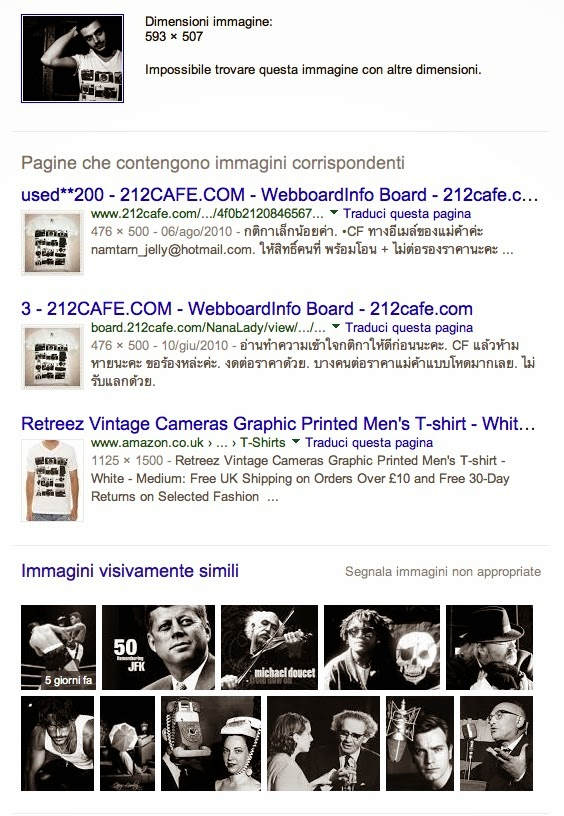
11 di 11 VISIVAMENTE SIMILI

Ricerca di immagini "visivamente simili" tramite il motore di ricerca Google. Le somiglianze, basate su forme e colori piuttosto che contesti, ci raccontano come ci vede un algoritmo di ricerca, per il quale è tutto immanente e al tempo stesso apparenza.

Questa performance espositiva è dedicata a Vito Ferro


* * *

L’occasione per proporre questo progetto espositivo è 42, prima Stagione d'Arte e Cultura organizzata da Michele Di Erre e Andrea Gagliotta, presso la Sartoria Creativa: spazio di incontro, condivisione, progettazione e realizzazione culturale.

A fronte di altre opere sottratte indebitamente in occasione di precedenti mostre personali, la riflessione è stata inevitabile: a chi appartiene un’opera d’arte? A chi l’ha realizzata, anche se non è difficile ammettere che le idee siano molto più fluide e virali di quanto si possa supporre, nonostante ciascuno di noi, spesso, se ne attribuisca la paternità più o meno in buona fede; al pubblico, eppure consideriamo le barriere d’accesso alla fruizione dell’arte che l’attuale sistema dà per scontate, dai biglietti di ingresso alle mostre, fino al mercato dell’arte vero e proprio.

Se da un lato dunque il piacere estetico può travalicare nel desiderio di possesso, dall’altro appropriarsi di un’opera d’arte presuppone la sottrazione dell’opera stessa allo sguardo di tutto il restante pubblico: rubare qualcosa, in un certo senso, non lede solo il legittimo proprietario, ma la stessa collettività; viceversa, la proprietà egoista di un bene culturale ne vanifica il valore intimo, quello di essere pubblico e condivisibile. Per offrire ai visitatori della personale uno stimolo di confronto su queste tematiche, ogni giorno un’opera verrà lasciata incustodita: i visitatori, se lo desiderano, potranno portarla via senza essere visti.

Il messaggio sottinteso a questa esposizione performativa è preciso e diretto: a latere dei nostri giochi di attribuzione di valore, dei nostri desideri e delle previsioni in merito al destino di un’opera, in un modo o nell’altro l’arte percorre strade a noi non del tutto note,  continuando a proporre nuove visioni della realtà anche in assenza, e ben più a lungo dell’esistenza, dell’artista stesso.